Deprecated: strtr(): Passing null to parameter #1 ($string) of type string is deprecated in /chroot/home/a40b7614/774635bdc8.nxcli.io/html/wp-content/plugins/moosend-email-marketing/vendor/moosend/website-tracking/src/Utils/Encryption.php on line 8 Deprecated: urlencode(): Passing null to parameter #1 ($string) of type string is deprecated in /chroot/home/a40b7614/774635bdc8.nxcli.io/html/wp-content/plugins/moosend-email-marketing/vendor/moosend/website-tracking/src/Payload.php on line 202 togaf – SoftwareArchitect.ca

Tag: togaf

  • May the Fourth Sale

    May the Fourth Sale

    I usually send these out closer to the end of the month.

    But I just had a look at the calendar. It’s May 3rd right now. May the 4th is tomorrow.

    <Cue the Star Wars-themed sale.>

    Now I’m still waiting to receive all of that cute Baby Yoda gear I ordered at the beginning of the year. I suppose that’s all delayed right now.

    But you don’t have to way to get the biggest discount on my courses. Everything I have for $9.99 or $10.99 each… right now.

    I just launched a brand new course on the Azure DP-200 exam, Implementing Azure Data, which is one of the exams required to get a shiny Azure Data Engineer badge!

    Or I also finally created the TOGAF® 9.2 Part 2 course, which is the second exam required to get fully TOGAF® Certified?

    I’m almost done upgrading my bestselling AZ-103 / AZ-104 Azure Administrator course for the latest beta exam requirements. I invite you to learn the latest on Microsoft Azure with me.

    All of my Azure and TOGAF courses are available for US$9.99 (or $10.99) using the coupon code STARWARS. If there’s a course of mine that you like, “apply coupon” and use the code STARWARS. Thanks. (This coupon expires on Friday, May 8.)

    And May the Fourth Be With You.

    (P.S. Hope you are safe, and doing well.)

    (P.S.S. Please don’t sue me Disney and Lucasfilm. Love your movies!)

  • Brand New Course on The New TOGAF 9.2 Standard

    Brand New Course on The New TOGAF 9.2 Standard

    Here’s some brand new content from the SoftwareArchitect,ca YouTube channel that you might find interesting.

    Happy to announce my new TOGAF 9.2 Certification course on Udemy.

    https://www.udemy.com/togaf-part1/?couponCode=NEWLAUNCH

    The Open Group recently released the newest version of the the TOGAF Standard, version 9.2. The new standard makes some subtle changes to the specification. This course is all new, covering the standard from top to bottom. The focus is on the certification, but you do not have to want to get certified to find this course useful for learning TOGAF 9.

    The first version of this course was the most popular training product on TOGAF, with 28,000 students enrolled. Learn the new standard from the leading TOGAF trainer. Of course, since this course is on Udemy, you’ll never pay too much either. Affordable, approachable training.

    Quickstart Series: Windows Web App in Azure

    In this video, I show you how to create a Windows Web App in Microsoft Azure. Windows Web App. We go through the Azure Portal, and see how form fields get filled in. If you can’t afford to create resources in Azure, but want to see how it’s done in 2018, this is the video for you.

    Or you can see the video directly on YouTube.

    Transcript:

    For the first time in six years, The Open Group has released a new version of the TOGAF Standard. The new release is called the TOGAF Standard, Version 9.2. The TOGAF Standard has been restructured, going from a single, large specification to multiple, smaller documents. Here’s now the core framework plus several smaller guides as add-ons. The TOGAF Standard, Version 9.2 adds an additional focus on newer digital trends and business transformation beyond IT. In this course, I’ll prepare you for the TOGAF 9.2 Part 1 Exam by taking you through what you need to know to pass. More than 28,000 students have enrolled in the TOGAF 9.1 version of this course and I am pleased to be one of the first to market the training on this updated Standard. In this course, we’ll go through each of the requirements of the exam one by one. On screen, you’ll see the requirements of the exam and there are videos on each of them inside this course. You’ll learn all about the Architecture Development Method, ADM, which is the heart of the TOGAF Standard. I’ll give you a high-level overview of it to start but then dive deep into each of the phases of this process. You’ll learn about the role of the enterprise architect in an organization, and how we go about our work to get the business in alignment with its own goals. Over 4,000 students have left a four or five-star review on the first version of this course, and this new course has been completely revised and updated to be even better. You’ll get the same great quality you come to expect from me, including high quality video lessons, quiz questions, downloadable audio files, so that you can learn on the go, and lifetime access to materials. TOGAF skills are among the highest paying skills according to regular salary surveys, and so if you want to improve your team’s architecture capability or put yourself in a position for a new job, sign up right now for this groundbreaking new course and put yourself above the pack.

  • TOGAF 9.2 What’s New

    TOGAF 9.2 What’s New

    Here’s some brand new content from the SoftwareArchitect.ca YouTube channel that you might find interesting.

    TOGAF 9.2 What’s New

    In this video, we look at the brand new TOGAF® 9.2 standard that was just released in April 2018, and go over the four main differences from the version 9.1 of the standard.

    Quickstart Series: Windows Web App in Azure

    In this video, I show you how to create a Windows Web App in Microsoft Azure. Windows Web App. We go through the Azure Portal, and see how form fields get filled in. If you can’t afford to create resources in Azure, but want to see how it’s done in 2018, this is the video for you.

    Or you can see the video directly on YouTube.

    Transcript:

    Well hi there. My name is Scott Duffy from Software Architect dot ca and in this video I’m going to talk about the brand new TOGAF 9.2 standard and tell you the differences between that and TOGAF 9.1. If you’re not aware the open group just released the TOGAF 9.2 standard in April of 2018. Now I’ve gone through it and I’m highlighting the differences between that and TOGAF 9.1 for you. So you might be wondering what is the difference. Well I’m going to pull out four things specifically that I’ll talk about today. The four things are number one they’re starting to treat the TOGAF standard as a modular standard or a modular structure so the TOGAF 9.1 standard came up to 650 printed pages and so the TOGAF 9.2 standard is now 500 pages. They’ve been able to pull out 150 pages. Some of those pages have just been removed and some of them have put into other documents that are called TOGAF series guides. To give you an example, the TRM which is a technical reference model and the III-RM, are both now in a series guide and is not part of the core specification.

    Now why are they making it modular? Well first of all there were a few things in there that are examples and they were not part of the core standard so they were putting in reference models and some examples with other standards and it wasn’t really contributing to the standard itself. It was just basically extra content, so they started removing some of this extra content and one of the problems they found with the TOGAF 9.1 standard was that it was so big 650 pages it’s hard to make substantive changes to that. Because it a big monolithic document going in there and starting to make changes, there were just pages and pages, hundreds of change requests that were being submitted and they were just not able to go through and deal with all of this and so they’re breaking up the document into the core standard and into series guides and it’s going to make it easier in the future like if they do come out with the major change, if they come out with TOGAF 10, it’ll be easier to create that if things are modular.

    The second difference between TOGAF 9.2 and TOGAF 9.1 is that they’re starting to make some changes to the way that the business phases are handled and so right now in the TOGAF 9.1 standard you go into the architect’s revision phase and you come up with an architect’s revision, but you’re not really dealing with the business problems. So now, in the architect’s revision phase they’re having things about the business model, defining business capability, et cetera. There’s new artifacts being added to the vision phase and so it’s basically pulling forward some of the discussions of the problems of the business from phase B into phase A which makes sense.

    The third thing that I’ll talk about is if you look at the definitions section for 9.1, there’s already lots and lots of pages devoted to terms. Well 9.2 has added a whole bunch of definitions and so now having a standard set of terms is one of those foundational concepts of the TOGAF standard because having a common language allows us to talk about enterprise architecture and when I say, you know talking about the enterprise you’ll know that the definition of the word enterprise is because that’s defined in the standard. So now there are more definitions that are being standardized. Part of this is because the ISO, the international standards organizations are coming up with architecture documents and they’re standardizing terms in there as well and so basically it’s aligning the TOGAF standard with the ISO 42010 standard for 2011.

    And the fourth thing that I’m going to point out to you is the content meta model. If you’ll recall the TOGAF standard has defined … There’s a diagram which I won’t show you right now, but the diagram that defines the content meta model how all the documents, the processes and things relate to each other within the architecture repository, so now because we’re adding new artifacts into phase A and new artifacts into phase B, splitting up things that are treated as one element within TOGAF 9.1, then there’s a basically some additional changes to the content meta model. New entities on the diagram, revisions of existing entities, and new relationships between those entities and for instance they pulled out location into what’s called a global entity and as we get into the course for TOGAF we’ll talk about content meta model.

    So to be honest, looking over these changes majority of the document, of the 500 remaining pages have not changed. A lot of the chapters have no updates or just some reorganization of the content. I think what the open group is doing is setting itself up to be able to make more substantial changes in the future. So the TOGAF 9.2 standard can be treated like a true minor release of TOGAF, cleaning some things up. Again the big changes that I’ve outlined in this video in terms of content meta model, in terms of phase A and phase B, et cetera, definitions, those are basically some things that have been lingering for a while that have needed to change, but as we get into 2019, 2020, 2021 we should expect that there be other changes to TOGAF that are more substantial to address some of the changes of the businesses going into this last seven eight years a lot of businesses have changed, so expect the standard to change more frequently.

    To summarize this whole video. TL-DR basically they’ve cleaned some things up, fixed some bugs, fixed errors, removed unnecessary content, and they’re basically just setting themselves up for some easier things in the future for making changes of this standard. So this is the first few steps for updating the standard.

  • Top-Down versus Bottom-Up Approach in TOGAF

    Top-Down versus Bottom-Up Approach in TOGAF

    Within the TOGAF specification, you will sometimes read about there being two options for approaching the design of architecture: a top-down approach or a bottom-up approach.

    But what does that mean?

    ​The top-down approach means that you start with the business requirements (the B layer) and fully decide the problems your business needs to solve before thinking about the technology to solve those problems. The “bottom up” approach means you start with the technology that you are looking to add to your organization and work “up” to change the applications and the business.

    An example of this is, let’s say you have a problem with security. You talk to the business leaders, department heads, etc and come up with an extensive target business architecture for it. Then you start looking at vendors and thinking about implementation. That’s top-down.

    The bottom-up approach is, when you have a problem with security, talking to the technical teams and ops teams. What can you do to improve security? They might suggest you restrict all access from outside your company except through the VPN. You then work up to the business layer to say that certain policies need to be followed to get access to the company network from outside. That’s a top up approach. Thinking about solutions first and then changing the business needs to match.

    Hope that helps.


  • Become an Enterprise Architect Through Udemy for Business

    Become an Enterprise Architect Through Udemy for Business

    Hundreds of companies provide their employees access to Udemy as part of their employee training benefits. Is yours one?

    If so, you already have access to my Enterprise Architecture and Microsoft Azure courses for free!

    All you need to do is log in to your company’s Udemy portal, and search for TOGAF or Azure using Udemy’s search tool. You’ll be shown a selection of my courses where you can sign up at no cost to you – since your employer already pays to be part of that program.

    But clicking the “sign up” button doesn’t teach you the skill. (We’re not in The Matrix yet. “I know Kung Fu.”)

    You will need to watch the videos and practice the skills, and this can be done a little at a time. Perhaps the smartest thing you can do is book yourself a meeting in your Office calendar every week where nobody else is able to reserve that time away from you. Whether it’s 30 minutes, or an hour, or more. Book yourself a meeting, and devote that time to taking some training such as my TOGAF courses that will help you attain the certification that can advance your skills and advance your career.

    Over 800 companies have this as a company benefit, and yours might be one of them. So check with HR on what training platforms you have available.

    And if you don’t see my courses on the training platform you have (whatever it is), do me a favor and ask that training platform to get in touch with me and get my courses there.

    Scott


  • The Future of Enterprise Architecture

    The Future of Enterprise Architecture

    The question I’m asking myself today is, is there a future in Enterprise Architecture?

    That’s a tough question, I admit. And the answer seems fairly clear on both sides.

    OF COURSE, there’s a future. Companies need specialists who can shape their organization to match their business goals. Just like airlines will always need people who understand aerodynamics, companies need people who understand what is important to accelerate success, and what is getting in the way and causing drag. The role is absolutely critical for large companies.

    BUT we live in a time of agile development. We can’t sit back and wait months to execute on plans. If a company sees an opportunity in a new space, it needs to be able to quickly enter that market and establish some type of operation. It can’t wait one or two years for the next ADM cycle to start before deciding to improve it’s customer onboarding to increase retention.

    The solution, then, is that companies need to focus on speed as a capability. Giving business units the capability to operate quickly in changing markets, and putting processes in place to ensure those business units operate in-line with the overall business goals.

    In essence, it turns the enterprise architect role into establishing strong business problem-solving ability in smaller business units and ensure the business supports that, as opposed to trying to solve these business problems in one and two year cycles.

    We see a similar trend in the fashion industry. Fast Fashion is something that has emerged in the past 10 years or so. Fashion trends move quickly from the runway to the stores. If a style or a look becomes trendy, you can expect to see those styles on sale quickly instead of waiting 6-9 months for it to work its way through the traditional “design, planning, manufacturing, shipping, distribution” stages.

    Unfortunately, TOGAF has not yet evolved to meet this new “fast business” world that we live in. There seems to be a strain between the two worlds. There will always be the “big centralized” model that absolutely does not want or need “fast business” and has no incentive to move off these long cycles that make every move slow and deliberate. Meanwhile, many companies (including behemoths like Microsoft and Amazon) realize the need to be quicker to market with innovative products and are not worried about things being a little bit broken or imperfect because they can be fixed.


    I will end this with a bit of a favor. Completely optional of course. I want to ensure I’m giving you information that is useful to you. If you have an interest in TOGAF, enterprise architecture, and big trends that shape how large businesses operate, clicking here will let me know to focus on that. If you’re more interested in cloud technologies from an architect, developer or implementer perspective, clicking here will let me know to focus on that instead. And if they both interest you, then clicking here will ensure I deliver information about both.


  • Get Top Architecture Courses at Great Price

    Me2Hi there. Wanted to make a post today about my Udemy courses, and how you are able to get them at a discount using the links below.
    I really appreciate all of my students, and I have created these courses to help pass these architecture exams. I am constantly improving them, and so they’ll never be out of date to the specific exam that they teach.

    “Excellent content that covers the organization of TOGAF very well. Scott’s insights into the exam have been invaluable!” – Vinoo Palayoor

    TOGAF1

    TOGAF2


    “I really appreciated the content and how the whole lectures and material is organized, the small quizzes and the outside material hyperlinks. Really helpful !” – Jean-Francois Pezet

    TOGAF Part 1 Arabic

    Azure 70-534


    I have over 21,000 students in my architecture courses, and I look forward to having you as a student.

    Scott

  • The Open Group Changes Testing Centers

    The Open Group recently announced that they are switching from Prometric to Pearson VUE. For now, the TOGAF 9.1 exam is available at both testing centers (and in many cases, the same testing center supports both testing companies).  But at some point in the future, the exams will only be available through Pearson.

    The Open Group selects Pearson VUE for global computer-based IT certification testing programme delivery

    Source: The Open Group :: Pearson VUE

  • Using Baby Steps To Climb Mount TOGAF

    A few years ago, in the place I used to work, the company used to go out for drinks after work on Thursdays. One Thursday we were out, and a friend of mine said he was interested in learning TOGAF.

    TOGAF? What’s that?“, I replied.

    And that’s how it started for me. When I went home, I did some research. TOGAF was a certification for architects. I was immediately excited by the idea of being certified for being an architect, as the idea that you could had not even crossed my mind before then. I’ve taken several certifications in the past – Microsoft Developer, Sun Java (back when there was a Sun Microsystems), and others. Being certified for TOGAF actually sounded like a great opportunity to learn, and a good career move. So I set it as a goal.

    Opening the specification for the first time was a bit intimidating. The TOGAF 9.1 spec does not do a great job telling you what it is and introducing people to the subject of enterprise architecture. It just starts, and each paragraph is sometimes vague and unclear. It was not going to be easy.

    And maybe, quite possibly, this is where you are. You see this subject, it looks interesting, something you think will help you do your job and open new opportunities in the future. You’ve bought my course (or haven’t) but what now? How do you go from where you are to where you want to be?

    I’ve found in my life that you need to take things slowly sometimes. You cannot climb Mount Everest in a single day. You climb a big mountain by going from one base camp to the next, and take some time to rest and get acclimated at each stop. It actually usually takes around TWO MONTHS to climb Everest (normally arriving in March, and reaching the summit in May). Maybe you can climb Mount TOGAF in under two months, but you need to understand when you start that it’s not an overnight thing, or something that can be conquered in one week. Setting expectations is important.

    So how do you reach the top of Mount TOGAF if you are currently standing at the very bottom?

    For me, it was doing a little bit of studying each day. If you set aside even 30 minutes or 1 hour per day to understand a little bit more about TOGAF, you will have made a little progress towards your goal. Set a plan. And stick to it no matter what.

    Do you understand what the TOGAF definition of enterprise is? Good. Do you understand what the TOGAF definition of architecture is? Good. Do you understand the objectives of the Preliminary Phase of the ADM? Good. Just keep making a little progress each day. Only one lightbulb needs to go off for a study session to be productive. Just do a little bit each day, and after a week you will be a few meters up the mountain. And after two weeks, you might be half-way up the mountain.

    The worst thing you can do is put it off. Someday. If you go significant periods without looking at it, you might as well not do it. You can’t climb Mount TOGAF by only climbing once every two weeks. You need daily progress. And if you must miss a day, get back to it immediately the next day.

    If you want to get the occasional email from me about TOGAF and architecture topics, I invite you to join my mailing list. You’ll get a special study guide containing the key TOGAF definitions free just for signing up.

    [activecampaign form=1]


  • TOGAF 9.1 Study Resource – Key Terminology

    sa-blog-key-terminology

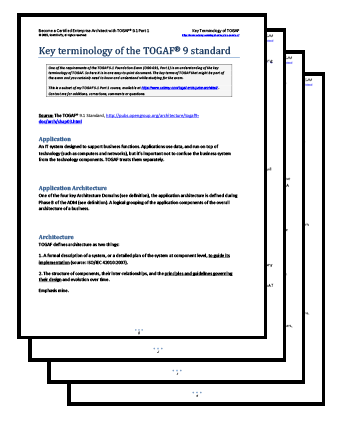
    New from SoftwareArchitect.ca, a FREE 8-page study resource for the TOGAF 9.1 Part 1 exam (OG0-091).  Print this, and take this with you as you study for the exam. Take this to the exam center on the day of the test, for some last-minute assurance before sitting down at the computer. Remember that you have to throw it out (or put it in a storage locker) before entering the exam room itself.

    [activecampaign form=1]

    In this document, I go over the 40 key terms of TOGAF. If you are studying for the exam, or just need to understand TOGAF better, you need to understand these key terms in order to understand exactly what is going on.

    TOGAF-Key-Terminology

    Doesn’t the TOGAF spec covers definitions?

    Yes, it does. But the spec contains 77 definitions for terms. In this guide, I only over the key ones, reducing the amount you have to memorize for the exam. I also use my own wording to simplify and expand upon the official meaning, to make it clearer for you what they mean when they use those words.

    Simply enter your email address below, and I’ll be happy to send you this 8-page essential study resource with all of the key definitions required for the TOGAF exams.

    [activecampaign form=1]