Deprecated: strtr(): Passing null to parameter #1 ($string) of type string is deprecated in /chroot/home/a40b7614/774635bdc8.nxcli.io/html/wp-content/plugins/moosend-email-marketing/vendor/moosend/website-tracking/src/Utils/Encryption.php on line 8 Deprecated: urlencode(): Passing null to parameter #1 ($string) of type string is deprecated in /chroot/home/a40b7614/774635bdc8.nxcli.io/html/wp-content/plugins/moosend-email-marketing/vendor/moosend/website-tracking/src/Payload.php on line 202 tips – Page 2 – SoftwareArchitect.ca

Tag: tips

  • Top Challenges of Enterprise, Software and Solution Architects

    Top Challenges of Enterprise, Software and Solution Architects

    A week or so ago, I ran a survey of the students in my architecture courses, asking them what their biggest challenges were.

    In this post, we’ll look at the top 5 answers, from real working architects and senior application developers like you:

    1. Dealing with Legacy Systems

    Without a doubt, as we get into the 40th year of having enterprise-level software systems, we’re all feeling a bit burdened by some of these pain-in-the-neck (and difficult to replace) systems.

    In fact, as I look back on the last 10 years of my career, I can’t really think of a project that wasn’t something like these:

    • a system where the original developer is gone, and no one fully understands the system
    • a system where, for whatever reason, no one wanted to have to touch if at all possible
    • a system that has been “planning to be replaced” for several years, with no concrete schedule as to when
    • a system where the original vendor doesn’t even support it any more (or indeed talk about it on their website)

    If I had a magic wand, and could update to the latest version, or replace it with something more modern instantly, for sure that magic wand would be used a lot. Unfortunately, company’s sometimes prioritize certain things very low on the list, and we have to deal with them.

    2. Explaining the Value of Architecture to Non-Architects

    Oh man. What is architecture? What IS it? What do architects DO?

    This question has been haunting people in the architecture space for ages. I even made not one, but two videos about it. (Please check those out, and subscribe!)

    The thing to remember is, every system has an architecture. Whether an architect was involved or not, one or more people made some decisions on systems design that add together to become the system architecture. But would you rather have something that is designed intentionally, or something that just comes together without forethought?

    If I offered you a house, and said that I built it one room at a time without thinking about any of the other rooms, does that sound like a well-designed house? Then why can computer systems (and ultimately the businesses that run on top of them) be designed only one room at a time and expect the whole house to make sense?

    (Why are there 3 bathrooms in the basement and none upstairs by the bedrooms? Because there was no architect.)

    3. Dealing with Application and Data Security

    In 2016, security is a huge issue that anyone in technology has to deal with. Not only is it smart business policy to protect your customers data from being exposed, but it’s actually the law in many places that this data has to be responsibly protected. As architects, we need to be on top of the standards for security and ensure that our designs have thought about that before code has been written or systems set up.

    Easier said than done, of course.

    But from the way customer data is kept, to the way our networks are hardened from attack, to the limitations we place on users from outside (including the website user itself which will minimize the effects of a web-facing break in) are more important than ever, and will never be something we can take for granted.

    4. Dealing with integration with other systems

    Legacy systems were a big headache, but even interacting with non-legacy systems can be complex. How do you package and send GBs of sensitive data from one server to another when the other system only accepts XML files in a specific file directory as input? Sometimes you end up with middle-tier “connector” systems that just move files around, and sometimes you need to use third-party solutions like Microsoft SQL Server Integration Services (SSIS) or Microsoft BizTalk to pass and manipulate data around.

    The ideal solution is for two systems to be designed to talk to each other, or use some industry standard protocol (an Industry Architecture on the Enterprise Continuum!) so that related systems can just work to implement a standard instead of worrying about direct integration with so many varying systems. But those standards are often overly complex (due to the number of irrelevant-to-you scenarios they have to deal with) or don’t exist for your specific need.

    5. Feeling locked in with a single vendor, such that parts of the architecture cannot be changed

    We’ve all been there. Your company has been using “Tool X” for analytics and reporting so long that the code is everywhere. In every web page, of every website. Highly customized for button clicks, opt-ins, video plays, and all sorts of events. And implemented slightly differently in every site it’s been added to. When asked, you estimate 12 person-months to swap out the “Tool X” code and replace it with another solution to the same level of customization for pages and events.

    Sometimes you’re stuck. The cost to replace something doesn’t give the business the necessary return on investment to spend that money. And so you go year after year, with a tool that no-one really likes, paying more for it than you probably should, because it’s tool difficult to replace.

    There’s no easy solution to that, except to vow that the next time you’re asked to implement some custom third-party code in all your web pages, you devise a system that puts that code in one central location. You need to abstract that and centralize it, so that it’s easy to upgrade to the newest version or swap out to a new vendor.

    Those were the top 5 issues identified by my students. Anything that I missed?

    [activecampaign form=7]
     

  • TOGAF 9.1 Study Resource – Key Terminology

    sa-blog-key-terminology

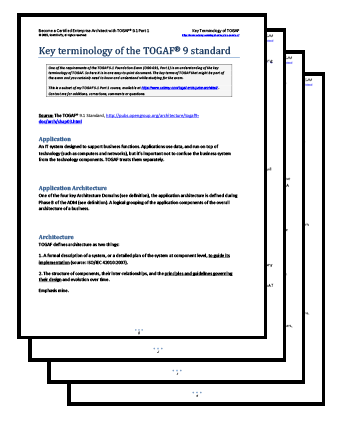
    New from SoftwareArchitect.ca, a FREE 8-page study resource for the TOGAF 9.1 Part 1 exam (OG0-091).  Print this, and take this with you as you study for the exam. Take this to the exam center on the day of the test, for some last-minute assurance before sitting down at the computer. Remember that you have to throw it out (or put it in a storage locker) before entering the exam room itself.

    [activecampaign form=1]

    In this document, I go over the 40 key terms of TOGAF. If you are studying for the exam, or just need to understand TOGAF better, you need to understand these key terms in order to understand exactly what is going on.

    TOGAF-Key-Terminology

    Doesn’t the TOGAF spec covers definitions?

    Yes, it does. But the spec contains 77 definitions for terms. In this guide, I only over the key ones, reducing the amount you have to memorize for the exam. I also use my own wording to simplify and expand upon the official meaning, to make it clearer for you what they mean when they use those words.

    Simply enter your email address below, and I’ll be happy to send you this 8-page essential study resource with all of the key definitions required for the TOGAF exams.

    [activecampaign form=1]

  • Tips for Passing the TOGAF 9.1 Part 2 Exam

    Tips for Passing the TOGAF 9.1 Part 2 Exam

    I put together a little list of study tips for you to give you a better idea of the strategy for studying for the exam. I hope you find it helpful.

    1) Eliminate the distractor first.

    When I was a kid, there was a TV program called Sesame Street. And it had a game on it called “Which of these things don’t belong?”

    The characters would then show three things (like, an apple, a banana, a pear, and a sock) and the goal was to figure out the one thing that didn’t belong in that group.

    In some ways, TOGAF Part 2 is a game of “Which of these things don’t belong?”

    Every set of answers on the Part 2 exam has 1 question worth zero points. It’s the obviously wrong answer. If you can figure out the obviously wrong answer on every question, you will almost certainly pass the overall test.

    2) Be familiar with the TOGAF 9.1 specification PDF.

    I did all my studying for the Part 1 exam based off the Open Group website. I found it easier to search in Google, and find the topic I was looking for in the spec that way. But when it comes to the Part 2 exam, you need to become best friends with the PDF.

    You need to know the sections of the document, the chapters. How it’s laid out. How to search inside a PDF. If you can be a master of quickly searching the PDF, you can “look up” the answer to every question on the test. You’ll know in general what to look for, and won’t waste time looking for it.

    3) Sample tests

    The Part 1 exam was about memorization to me, and so taking sample tests repeatedly wasn’t a recommended strategy. But the Part 2 exam is about reading, figuring out the essence of the question, ignoring irrelevant information, and finding the distractor.

    You absolutely MUST take sample tests before going in for the Part 2 exam. Being presented with that type of test without ever seeing it before would be a bad idea.

    This course contains a few sample questions, along with my explanations as to how I came up with the correct answer. (I will try to add more this month.) For 99 cents, buy the official Open Group sample tests as well. Well worth it.

    4) Set a goal. Pick the exam date now.

    If you give yourself 2 weeks to study for the exam, go ahead and book the exam with Prometric now. This will motivate you to study and give you a natural pace. You will know that you need to have covered the specification completely within the first week, and spend the last week reviewing, and taking sample tests. If you choose a date 3 weeks from now, your pace will be a bit slower. Having an end date is motivating.

    You can always change that date for free if it gets closer to the exam date and you feel you’re not ready.

    5) Just do it.

    For some reason, I’ve really gotten into that Shia LaBeouf motivational video. If you haven’t seen it, here’s the original. There have been hundreds of creative and funny edits to it. 

    Shia LaBeouf Motivational Video on Youtube

    “Don’t let your dreams be dreams. Yesterday you said tomorrow, so just do it.”

    I know that he’s mocking the motivational speaker industry, but it’s still somehow motivational to me. 🙂


  • Tips for Passing the TOGAF 9.1 Part 1 Exam

    Tips for Passing the TOGAF 9.1 Part 1 Exam

    I put together a little list of study tips for you to give you a better idea of the strategy for studying for the exam. I hope you find it helpful.

    1) First go shallow, then go deep.

    When trying to tackle a huge subject like TOGAF, you need to understand the purpose of it, and what it’s trying to achieve, before digging into the details.

    For instance, with the ADM, it’s better to understand the phases and their objectives first (all of them), and then go back and then learn the individual steps inside each phase.

    2) Set a goal. Pick the exam date now.

    If you give yourself 4 weeks to study for the exam, go ahead and book the exam with Prometric now. This will motivate you to study and give you a natural pace. You will know that you need to have covered the specification completely within two weeks, and spend the last two weeks reviewing, and taking sample tests. If you choose a date 2 weeks from now, your pace will be faster. Having an end date is motivating.

    You can always change that date for free if it gets closer to the exam date and you feel you’re not ready.

    3) Don’t take any sample exams until 10 days before your exam date.

    The thing about sample tests is that, after the first time you take them, taking them again isn’t a true test any more. You’ll begin to remember the answers to these specific questions. So resist the temptation to take the sample tests too early or too often.
    Once you feel you are ready to take the sample test and have a good chance of passing it, then go ahead.

    4) Discover a better way to study.

    We’re all different. Some of us prefer to learn by reading, while others prefer audio. Some need to be in a quiet room with no distractions, while others can play the videos in the same room that other family members are watching TV.

    If you’re finding it hard to learn the TOGAF information, change something. Instead of sitting on the sofa, sit at a table. If studying at night is difficult, try doing it first thing in the morning.

    5) Just do it.

    For some reason, I’ve really gotten into that Shia LaBeouf motivational video. If you haven’t seen it, here’s the original. There have been hundreds of creative and funny edits to it.

    Shia LaBeouf Motivational Video on Youtube

    “Don’t let your dreams be dreams. Yesterday you said tomorrow, so just do it.”

    I know that he’s mocking the motivational speaker industry, but it’s still somehow motivational to me. 🙂